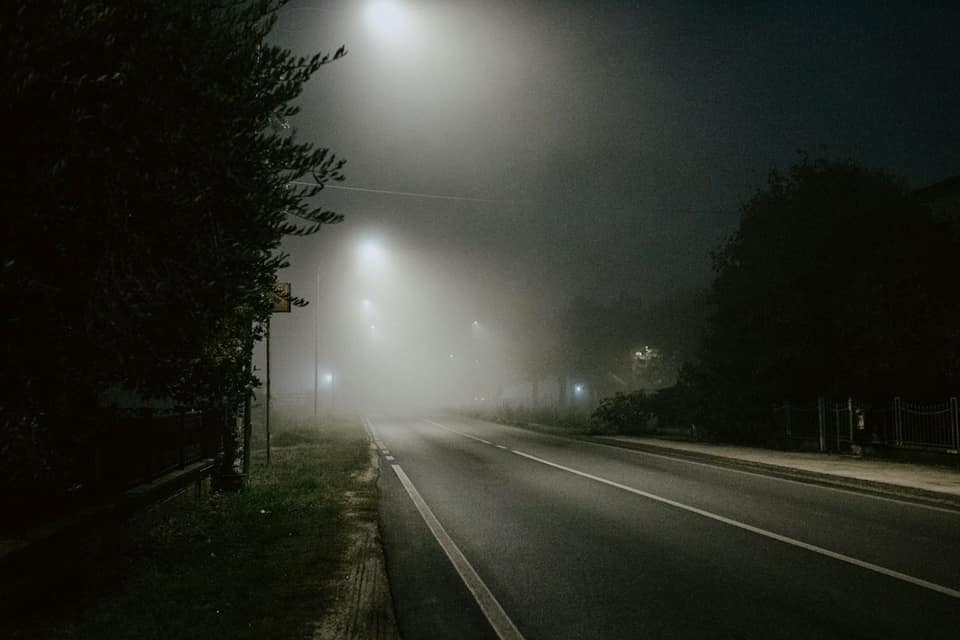
Most Singapore roads are well lit after dark. That can make night driving feel easier than it is. Shadows hide people, glare hides the road, and a tired driver misses things. Each section below covers one night-time situation and what a careful driver does in it.
Check the car before a night drive
Night driving starts before the engine does. Walk round the car once.
- Check both headlights, the tail lights, the brake lights and the indicators.
- Ask someone to watch the brake lights while you press the pedal. In an HDB car park, the reflection on a wall works too.
- Clean the windscreen inside and out. A film on the inside of the glass smears under oncoming lights.
- Wipe the mirrors and the headlamp covers.
- Make sure the wipers clear the glass without streaks.
Inside, turn the dashboard and screen brightness down. A bright screen reflects in the windscreen and makes the road outside look darker. Many screens have a night mode for this.
Use your headlights early and correctly
Switch your headlights on at dusk, not when it is fully dark. The point is not only to see. It is to let others see you.
One common mistake is driving on bright city streets with only daytime running lights on. On some cars the tail lights stay off in that setting. The front looks lit, but the back is dark to the driver behind. Check the light symbol on your dashboard, not just the glow on the road.
The rules on when lights must be on are set by LTA. Check OneMotoring for the current rules rather than relying on habit.
Use high beam only on unlit stretches with nobody ahead of you or coming the other way. Dip it as soon as you see oncoming lights or close up behind another car. On most Singapore roads, street lighting means high beam is rarely needed. Fog lights are not for normal night driving. If you are unsure when they may be used, check OneMotoring.
Handle glare from other cars
Oncoming headlights can leave you briefly blind. Do not look straight into them. Shift your eyes to the left edge of your lane and follow the line until the car passes.
If you are dazzled, ease off the accelerator. Keep a longer gap to the car ahead so you have time to react once your eyes recover.
Glare from behind is easier to fix. Flip the rear-view mirror to its night setting, or use the auto-dim function if the car has one. Adjust the side mirrors slightly outward if a high car behind is shining into them.
If you wear glasses, keep them clean. Tinted lenses cut light you need at night, so keep them for daytime.
Know the signs of tiredness
Late drives often come at the end of a long day. Tiredness creeps in slowly, and the driver is often the last to notice.
Watch for these signs:
- Yawning often or heavy eyelids.
- Drifting within the lane or touching the lane markings.
- Missing an exit or a turn you know well.
- Not remembering the last few kilometres.
If any of these happen, stop at a safe place such as a petrol station or a car park. A short rest helps. Opening the window or turning up the radio does not fix tiredness. It only hides it for a few minutes.
Expressways have few places to stop. Before a long night drive, plan where you could pull off. If someone else in the car can drive, share the driving.
Look twice for motorcyclists
At night a motorcycle is often just a single light. From a distance it can look like a car further away. It can also blend into street lamps and shop signs.
Motorcyclists often ride between lanes in slow traffic. Before a lane change, check your mirror, then your blind spot, then the mirror again. Signal early so a rider has time to see your intention.
At junctions, take extra care when turning right across traffic. A single light behind a bus or a lorry is easy to miss. Wait until you are sure the road is clear.
Watch for pedestrians in the shadows
Pedestrians in dark clothing can be hard to see until they are close. They are most likely near hawker centres, bus stops, MRT stations and the edges of HDB estates.
Some cross away from crossings, often late at night when roads look empty. Older pedestrians may need more time to cross. Children may run out between parked cars.
Slow down near bus stops. People sometimes step out from in front of a stopped bus. Cyclists and personal mobility device users may have weak lights or none at all. Give them plenty of room when you pass.
Take care in car parks and at junctions
Multi-storey and basement car parks are bright in places and dark behind pillars. Keep your headlights on inside. Drive slowly, and expect people to walk out from between cars.
When you reverse out of a lot, go slowly and look all round. Others may not see your reversing lights against the car park lighting.
At quiet junctions late at night, some drivers treat signals casually. Do not assume a green light means the road is clear. Look both ways before you move off.
Drive more slowly in rain at night
Rain at night makes everything harder. Wet roads reflect every light, and lane markings can almost disappear.
- Slow down and leave a longer gap.
- Keep your headlights on low beam. High beam reflects off the rain.
- Use the demister so the windscreen stays clear.
- Follow the kerb or the road edge if the lane lines fade.
The rules on using hazard lights in heavy rain are set by LTA. Check OneMotoring rather than guessing.
Plan a late drive before you leave
A little planning makes a night drive calmer.
- Set your route and your phone before you move off.
- Check you have enough fuel or charge for the trip.
- If your route passes ERP gantries, check the current rates on OneMotoring.
- Tell someone when you expect to arrive on a long or late trip.
- Avoid driving when you have been awake for many hours.
Older drivers and night driving
Some drivers find glare and low light harder to handle as they get older. A regular eye check helps you know where you stand. If night driving starts to feel stressful, plan more trips in daylight.
Insurance can change with age too. The site's page on car insurance for older drivers shows prices for drivers aged 55 to 80. As listed on 26 October 2026, for a 3-year-old Toyota Corolla Altis 1.6 with a 50% no-claim discount, the lowest price was S$642.42 at 55 and S$1,014.38 at 80. The same page shows that fewer insurers quote online as the driver gets older. At 80, only 2 of the insurers counted gave an online price.
If something happens at night
If you have an accident or a breakdown, stop somewhere safe if you can. Switch on your hazard lights. On an expressway, get everyone out of the car and away from traffic, behind the barrier if it is safe.
For what to report and when, follow the Singapore Police Force's rules for traffic accidents. The claims page explains how a car insurance claim works, and the no-claim discount page explains how a claim can affect your NCD.
Car insurance through Shenton Brokers
Before you drive off or renew, get your car insurance through Shenton Brokers. See which cars cost least to insure, or look up your own model's prices from every insurer we compare. Or get a quote with your own details.