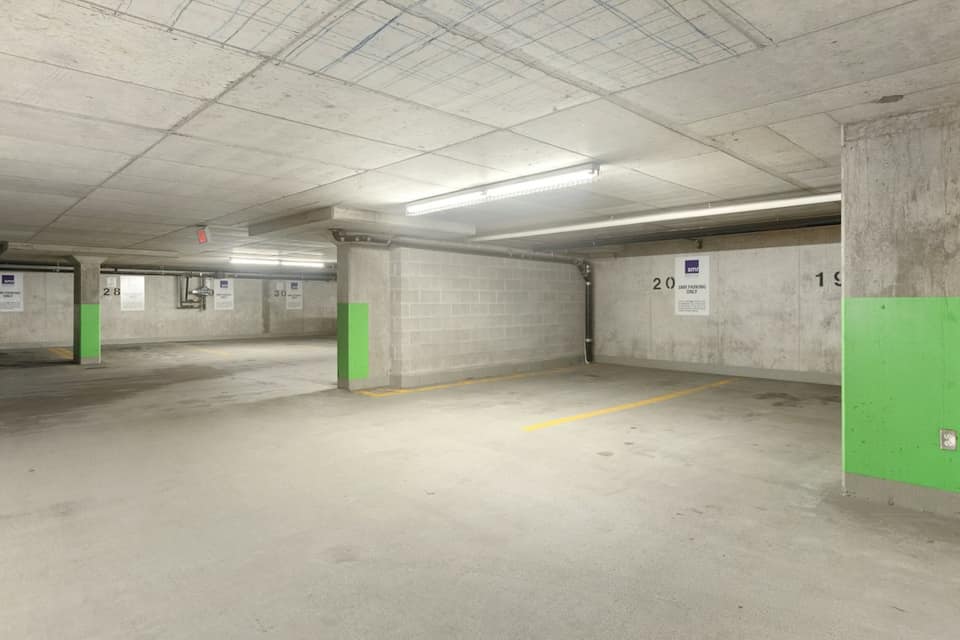
Many small dents and scrapes in Singapore happen at walking pace. They happen in HDB multi-storey car parks, where ramps curve tightly, bays sit beside pillars and the next car is close. None of it is hard. It just needs a few steady habits, used every time.
Check the entrance before you commit
Every multi-storey car park shows a height limit at the entrance. Know your car's height. If you have fitted a roof box, bike rack or roof rack, the car is now taller than it was. Read the sign before you turn in, not as the barrier comes up.
At the gantry, line the car up straight and early. The island under the reader has a kerb, and rims often get scuffed on it. Stop close enough to reach the reader without leaning far out. If you misjudge it, open the door gently rather than edging the car sideways against the kerb.
Ramps: slow, steady and away from the inner kerb
Spiral and corner ramps are where rims, tyres and side panels meet concrete. On a turn, the rear wheels follow a tighter line than the front wheels. So the inner rear wheel cuts closer to the kerb than you expect.
A careful driver on a ramp:
- Keeps a low, even speed and avoids braking hard mid-turn.
- Steers a little wider than feels natural, staying inside their own lane.
- Turns on the headlights in dim decks so oncoming cars see them.
- Expects a car coming down to cut the corner on a blind bend.
- Takes the crest and foot of a steep ramp slowly, so a low front bumper does not catch.
If you meet a car head-on on a narrow section, stop and let one of you reverse to a wider point. Squeezing past is how mirrors and doors get scraped.
Choosing a bay
Not every bay is equally easy. A few seconds of choosing saves a lot of shuffling.
- Bays beside a wall give you one side with no car door to worry about.
- Bays beside a pillar are harder to get in and out of. The pillar often sits near where your front or rear corner swings.
- Bays next to a car parked over the line leave you less room than the markings suggest.
- Bays at the end of a ramp turn sit where other drivers swing wide.
If a bay looks tight, drive on to the next one or the next deck. There is no prize for fitting into the hardest space.
Pillars and the corners you cannot see
Most pillar scrapes land on two places: the rear door or rear quarter, and the front corner of the bumper.
When you drive forward into a bay, the rear wheels cut inside the front. The side of the car closest to the turn can sweep into a pillar. When you reverse in, the front of the car swings outwards. The front corner on the far side can clip a pillar or the car next to you. Glance at that front corner as you turn, not only at the mirrors behind.
Reversing in, one step at a time
Reversing in takes a little longer to park but makes leaving easier. You drive out forwards with a clear view of the aisle. A simple routine:
- Drive slowly past the bay and stop a little beyond it, with space between you and the parked cars.
- Check both mirrors and look over your shoulder for people, trolleys and moving cars.
- Turn the wheel and reverse very slowly. Watch the side mirror for the bay line and any pillar.
- Straighten the wheel once the car is parallel with the lines.
- Stop when the rear wheels reach the wheel stoppers, or well short of the wall if there are none.
If the angle looks wrong, stop and pull forward to start again. One correction made early is better than a scrape made late. If your car can tilt the passenger mirror down when reversing, it helps you see the kerb and the line.
Sensors and cameras help, but they do not replace looking
Parking sensors and cameras make tight car parks easier. They also have limits.
- Sensors can miss thin poles, chains, low kerbs and wheel stoppers.
- A pillar edge met at an angle may not register until it is very close.
- Camera lenses are wide-angle, so distances on the screen can look larger than they are.
- Rain, dirt or condensation on the lens blurs the picture.
- Surround-view images are stitched together and can bend straight lines near the seams.
Use the screen as one view among several. Keep checking the mirrors and turn your head. Wipe the camera lens when you wash the car.
Doors, boots and getting out
Not all scrapes come from driving. Door dings happen when a door swings into the car next door. On open top decks, a gust of wind can pull a door from your hand.
- Open the door slowly and keep a hand on it.
- Remind passengers, especially children, to do the same.
- If your car can fold its mirrors, fold them in a tight bay.
- Check the ceiling height before opening a tall tailgate under a low beam or pipe.
If you scrape something, or someone scrapes you
Stop and check. If you have touched another car or car park property, do not drive off. Leave your details, or find the owner if you can.
Then record what happened:
- Take photos from a distance and close up, including both cars and their number plates.
- Note the deck level, the lot number and the time.
- Exchange names, contact details and vehicle numbers with the other driver.
The rules on when and how to report an accident are set out by the Singapore Police Force and on LTA's OneMotoring site. Your policy may also ask you to report every accident to your insurer, even one you do not claim for, within a set time. Check yours. The site's claims page lists where each insurer takes car claims.
A small scrape: claim or pay yourself
A scrape that looks minor can still cost real money to repair and repaint. Before deciding, get a repair quote, then weigh it against two things on your policy.
The first is your excess. This is the part of each own-damage claim you pay yourself. The site's car insurance excess page shows the excess on each insurer's lowest-priced comprehensive plan. That is for a 3-year-old Toyota Corolla Altis 1.6, authorised workshop, a driver aged 40 with 50% NCD, with prices as of 28 Oct 2026. The excess runs from S$500.00 to S$3,000.00, and the middle figure is S$600.00. With a S$600 excess and a S$2,000 repair, you pay S$600 and the insurer pays S$1,400. Young, new or unnamed drivers often carry an extra excess on top.
The second is your no-claim discount. A claim can reduce it at renewal, and that cost lasts beyond one year. How much it drops depends on your policy. The site's no-claim discount page explains how it works.
It also helps to know whether your plan sends repairs to an authorised workshop or lets you choose any workshop. The authorised or any workshop page sets out the difference. To see the excess beside each plan's premium for your own car, you can compare car insurance with your own details.
The habits above cost nothing. Slow ramps, a careful choice of bay and a patient reverse keep most of these questions from coming up at all.
Car insurance through Shenton Brokers
Before you drive off or renew, get your car insurance through Shenton Brokers. See which cars cost least to insure, or look up your own model's prices from every insurer we compare. Or get a quote with your own details.